

-
1 длительный допустимый ток
- Strombelastbarkeit, f
- Dauerstrombelastbarkeit, f
(длительный) допустимый ток
Максимальное значение электрического тока, который может протекать длительно по проводнику, устройству или аппарату при определенных условиях без превышения определенного значения их температуры в установившемся режиме
[ ГОСТ Р МЭК 60050-826-2009]
Этот ток обозначают IZ
[ ГОСТ Р 50571. 1-2009 ( МЭК 60364-1: 2005)]EN
(continuous) current-carrying capacity
ampacity (US)
maximum value of electric current which can be carried continuously by a conductor, a device or an apparatus, under specified conditions without its steady-state temperature exceeding a specified value
[IEV number 826-11-13]
ampacity
The current in amperes that a conductor can carry continuously under the conditions of use without exceeding its temperature rating.
[National Electrical Cod]FR
courant (permanent) admissible, m
valeur maximale du courant électrique qui peut parcourir en permanence, un conducteur, un dispositif ou un appareil, sans que sa température de régime permanent, dans des conditions données, soit supérieure à la valeur spécifiée
[IEV number 826-11-13]Ampacity, the term is defined as the maximum amount of current a cable can carry before sustaining immediate or progressive deterioration. Also described as current rating or current-carrying capacity, is the RMS electric current which a device can continuously carry while remaining within its temperature rating. The ampacity of a cable depends on:
- its insulation temperature rating;
- conductor electrical properties for current;
- frequency, in the case of alternating currents;
- ability to dissipate heat, which depends on cable geometry and its surroundings;
- ambient temperature.
Electric wires have some resistance, and electric current flowing through them causes voltage drop and power dissipation, which heats the cable. Copper or aluminum can conduct a large amount of current before melting, but long before the conductors melt, their insulation would be damaged by the heat.
The ampacity for a power cable is thus based on physical and electrical properties of the material & construction of the conductor and of its insulation, ambient temperature, and environmental conditions adjacent to the cable. Having a large overall surface area may dissipate heat well if the environment can absorb the heat.
In a long run of cable, different conditions govern, and installation regulations normally specify that the most severe condition along the run governs the cable's rating. Cables run in wet or oily locations may carry a lower temperature rating than in a dry installation. Derating is necessary for multiple circuits in close proximity. When multiple cables are near, each contributes heat to the others and diminishes the amount of cooling air that can flow past the individual cables. The overall ampacity of the insulated conductors in a bundle of more than 3 must be derated, whether in a raceway or cable. Usually the de-rating factor is tabulated in a nation's wiring regulations.
Depending on the type of insulating material, common maximum allowable temperatures at the surface of the conductor are 60, 75 and 90 degrees Celsius, often with an ambient air temperature of 30°C. In the U.S., 105°C is allowed with ambient of 40°C, for larger power cables, especially those operating at more than 2 kV. Likewise, specific insulations are rated 150, 200 or 250°C.
The allowed current in cables generally needs to be decreased (derated) when the cable is covered with fireproofing material.
For example, the United States National Electric Code, Table 310-16, specifies that up to three 8 AWG copper wires having a common insulating material (THWN) in a raceway, cable, or direct burial has an ampacity of 50 A when the ambient air is 30°C, the conductor surface temperature allowed to be 75°C. A single insulated conductor in air has 70 A rating.
Ampacity rating is normally for continuous current, and short periods of overcurrent occur without harm in most cabling systems. The acceptable magnitude and duration of overcurrent is a more complex topic than ampacity.
When designing an electrical system, one will normally need to know the current rating for the following:- Wires
- Printed Circuit Board traces, where included
- Fuses
- Circuit breakers
- All or nearly all components used
Some devices are limited by power rating, and when this power rating occurs below their current limit, it is not necessary to know the current limit to design a system. A common example of this is lightbulb holders.
[http://en.wikipedia.org/wiki/Ampacity]
Тематики
- электротехника, основные понятия
Синонимы
EN
DE
- Dauerstrombelastbarkeit, f
- Strombelastbarkeit, f
FR
- courant admissible, m
- courant permanent admissible, m
Русско-немецкий словарь нормативно-технической терминологии > длительный допустимый ток
-
2 нестекающая изоляция, пропитанная в массе
- haftmassegetränkte Papierisolierung, f
нестекающая изоляция, пропитанная в массе
бумажная изоляция, пропитанная в массе, в которой пропиточный состав не вытекает при максимальной длительной рабочей температуре
[IEV number 461-02-07]EN
mass-impregnated non-draining insulation
mass-impregnated paper insulation in which the impregnant is not fluid at the maximum continuous operating temperature
[IEV number 461-02-07]FR
isolation à matière stabilisée
isolation au papier par imprégnation à masse dans laquelle le produit d'imprégnation n'est pas fluide à la température maximale en service continu
[IEV number 461-02-07]Тематики
- кабели, провода...
EN
DE
- haftmassegetränkte Papierisolierung, f
FR
Русско-немецкий словарь нормативно-технической терминологии > нестекающая изоляция, пропитанная в массе
-
3 термопластичная изоляция
- thermoplastische Isolierung, f
термопластичная изоляция
изоляция из пластмассы, способной неоднократно размягчаться при нагревании и затвердевать при охлаждении в пределах установленного для данной пластмассы диапазона температур, а также неоднократно формоваться в размягченном состоянии при экструзии
[IEV number 461-02-10]EN
thermoplastic insulation
insulation made of a plastic capable of being repeatedly softened by heating and hardened by cooling through a temperature range characteristic of the plastic and, in the softened state, capable of being repeatedly shaped by extrusion
[IEV number 461-02-10]FR
isolation thermoplastique
isolation constituée d'un plastique susceptible d'être, de manière répétée, successivement ramolli par chauffage et durci par refroidissement dans un intervalle de température caractéristique du plastique considéré et, à l'état ramolli, d'être mis en forme par extrusion
[IEV number 461-02-10]Тематики
- кабели, провода...
EN
DE
- thermoplastische Isolierung, f
FR
Русско-немецкий словарь нормативно-технической терминологии > термопластичная изоляция
-
4 масляный трансформатор
масляный трансформатор
Трансформатор с жидким диэлектриком, в котором основной изолирующей средой и теплоносителем служит трансформаторное масло
[ ГОСТ 16110-82]
масляный трансформатор
Трансформатор, магнитная система и обмотки которого погружены в масло
(МЭС 421-01-14)
[ ГОСТ 30830-2002]EN
oil-immersed type transformer
a transformer of which the magnetic circuit and windings are immersed in oi
[IEV number 421-01-14]FR
transformateur immergé dans l'huile
transformateur dont le circuit magnétique et les enroulements sont immergés dans l'huile
[IEV number 421-01-14]Oil transformers
The magnetic circuit and the windings are immersed in a liquid dielectric that provides insulation and evacuates the heat losses of the transformer.
This liquid expands according to the load and the ambient temperature. PCBs and TCBs are now prohibited and mineral oil is generally used. It is flammable and requires protective measures against the risks of fire, explosion and pollution.
The most commonly used protective measures are the DGPT or the DGPT2: Gas, Pressure and Temperature sensor with 1 or 2 sensing levels on the temperature. This system cuts off the LV load (1st level) then the HV supply (2nd level) when there is a fault inside the transformer. A holding tank is used to recover all the liquid dielectric.
Of the four types of immersed transformer: free breathing transformers, gas cushion transformers, transformers with expansion tank and transformers with integral filling, only the latter are currently installed.
[Legrand]Масляные трансформаторы
Магнитная система и обмотки трансформатора погружены в жидкий диэлектрик, служащий изоляцией и теплоносителем.
Жидкий диэлектрик изменяет свой объем в соответствии с нагрузкой трансформатора и температурой окружающей среды. Поскольку в настоящее время применение полихлорированных дифенилов и тетрахлорбифенилов запрещено, то в основном используют минеральное масло. Оно огнеопасно, поэтому необходимо принимать меры против возникновения пожара, взрыва и загрязнения окружающей среды.
Как правило, применяются системы DGPT (одноуровневые системы, использующие датчики газа, давления и температуры) или DGPT2 – двухуровневые системы. В случае возникновения аномального состояния трансформатора данные системы отключают нагрузку цепей низшего напряжения (первый уровень защиты), а затем питание обмотки высшего напряжения (второй уровень защиты). Активная часть трансформатора находится в баке и полностью покрыта жидким диэлектриком.
Существует четыре типа масляных трансформаторов: трансформаторы с системой свободного дыхания, трансформаторы с газовой подушкой между зеркалом масла и крышкой трансформатора, трансформаторы с расширительным баком и трансформаторы с гофрированным баком. В настоящее время применяют только трансформаторы последнего типа
[Интент]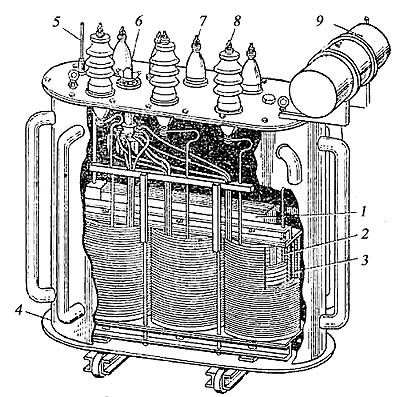
[http://www.ramo-chelny.ru/konschasti.html]Масляный трансформатор:
- Шихтованный магнитопровод
- Обмотка низшего напряжения
- Обмотка высшего напряжения
- Трубчатый бак
- Термометр
- Переключатель регулировочных отводов обмотки высшего напряжения
- Ввод (проходной изолятор) обмотки низшего напряжения
- Ввод (проходной изолятор) обмотки высшего напряжения
- Расширительный бак
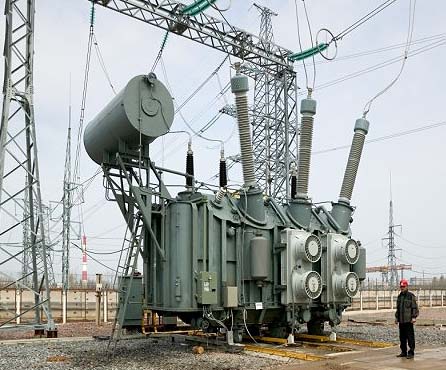
[http://transfcomplect.narod.ru/transformator.html]Тематики
Классификация
>>>EN
DE
FR
Русско-немецкий словарь нормативно-технической терминологии > масляный трансформатор
См. также в других словарях:
High temperature insulation wool — Microscopic close up of ceramic fibre … Wikipedia
high-temperature insulation — šilumai atspari izoliacija statusas T sritis automatika atitikmenys: angl. high temperature insulation; temperature resistant insulation vok. wärmebeständige Isolation, f rus. теплостойкая изоляция, f pranc. isolation résistante à la chaleur, f … Automatikos terminų žodynas
temperature-resistant insulation — šilumai atspari izoliacija statusas T sritis automatika atitikmenys: angl. high temperature insulation; temperature resistant insulation vok. wärmebeständige Isolation, f rus. теплостойкая изоляция, f pranc. isolation résistante à la chaleur, f … Automatikos terminų žodynas
temperature stress — ▪ physiology physiological stress induced by excessive heat or cold that can impair functioning and cause injury or death. Exposure to intense heat increases body temperature and pulse rate. If body temperature is sufficiently high,… … Universalium
Dynamic insulation — is a form of insulation where cool outside air flowing through the thermal insulation in the envelope of a building will pick up heat from the insulation fibres. Buildings can be designed to exploit this to reduce the transmission heat loss (U… … Wikipedia
R-value (insulation) — The R value or R value is a measure of thermal resistance (K·m²/W) [Oak Ridge National Laboratory, [http://www.ornl.gov/sci/roofs+walls/insulation/ins 02.html Which Kind Of Insulation Is Best?] , retrieved 2008 07 13.] used in the building and… … Wikipedia
Thermal insulation — The term thermal insulation can refer to materials used to reduce the rate of heat transfer, or the methods and processes used to reduce heat transfer.Heat energy can be transferred by conduction, convection, radiation or when undergoing a phase… … Wikipedia
Pipe insulation — is thermal insulation used to prevent heat loss and gain from pipes, to save energy and improve effectiveness of thermal systems.The benefits include, in addition to reducing costs and environmental impacts of energy consumption: [ 3E plus page… … Wikipedia
Installing building insulation — Due to the variety of building insulation materials available and the various building elements that may require insulation, there are a number of ways of installing building insulation.Where to insulateWhere to insulate depends on where your… … Wikipedia
Multi-layer insulation — Closeup of Multi layer insulation from a satellite. The metal coated plastic layers and the scrim separator are visible. Multi layer insulation, or MLI, is thermal insulation composed of multiple layers of thin sheets often used on spacecraft. It … Wikipedia
Building insulation — refers broadly to any object in a building used as insulation for any purpose. Whilst the majority of insulation in buildings is for thermal purposes, the term also applies to acoustic insulation, fire insulation, and impact insulation. Often an… … Wikipedia
